Ubuhlakani Bokwenziwa Ekukhiqizweni Kwamazambane: Kusukela Kudatha Kuya Esinqumweni Sezolimo
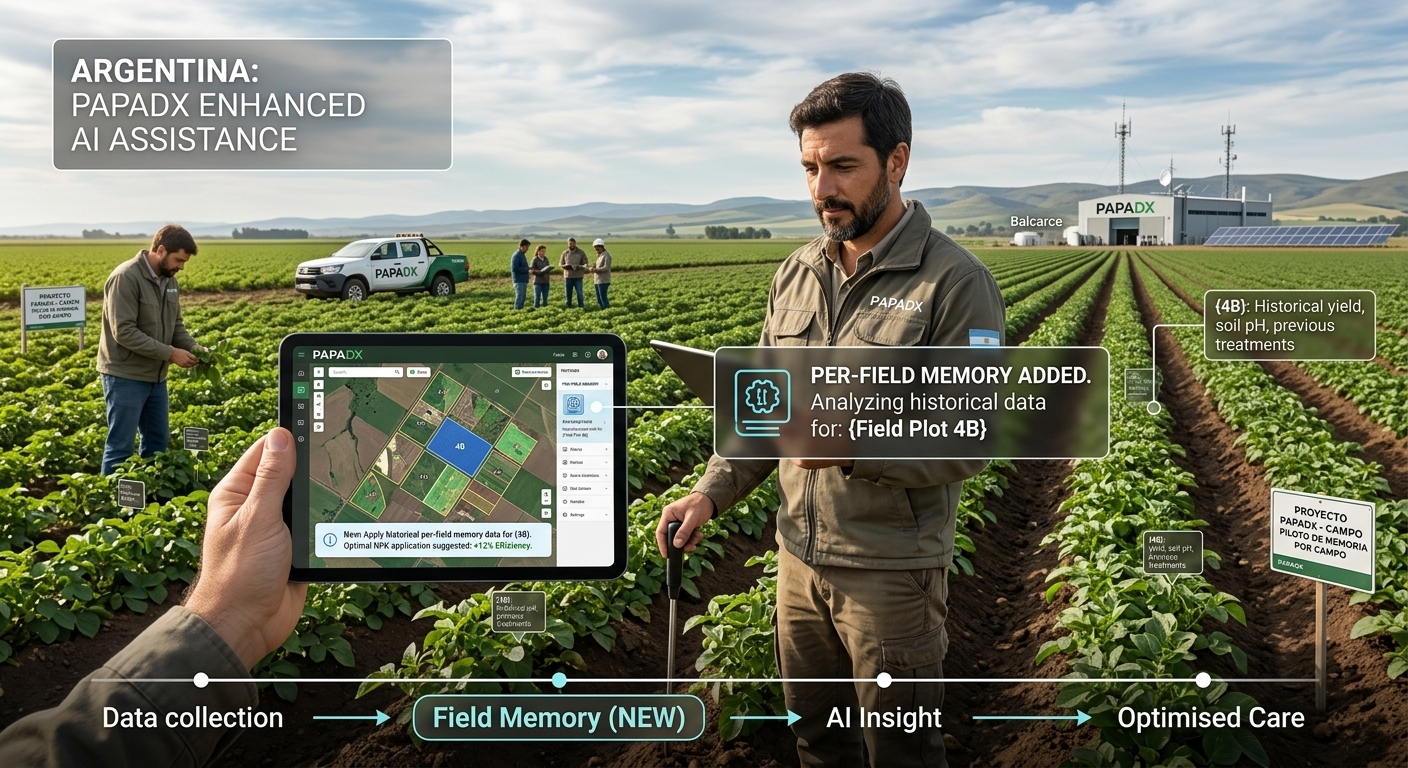
A recent Argentine conference examined how algorithms are reshaping the agronomist’s profession — and what that shift means for growing, storing and selling potatoes.
The 10th Responsible Production Conference (Jornadas de Producción Responsable), organised by the Tandil Association of Agricultural Engineers (CIAT) together with Argentina’s National Institute of Agricultural Technology (INTA), was held on 19 August 2026 under the theme “Professional practice in the age of algorithms.” Its conclusions apply directly to potato, a crop that is unusually intensive in capital, inputs, information and decisions.
The bottleneck has moved
Three decades ago the hard part was obtaining information. Later it became processing it. Today digital platforms and AI systems can download, organise and analyse very large volumes of data — but that capability alone does not guarantee a good decision.
Izinsuku zeviki. Zikhiphe ohlwini ngokuchofoza okukodwa.
In potato it is now possible to combine satellite and drone imagery, weather stations, soil moisture sensors, laboratory analyses, application records, yield maps, field disease histories and economic data. More information, however, does not automatically translate into better production.
Value appears when the data answers a specific question: where and when to irrigate, how to adjust fertilisation, which parts of the field warrant a physical inspection, where disease pressure is highest, when harvest should begin. Satellite, climate and sensor data stop being the end point of the analysis and become the starting point of an agronomic decision.
Three professional positions in front of AI
One of the conference’s sharpest contributions was a redefinition of the agronomist’s role. Manual data collection and processing will take up less of the job; interpretation, contextualisation and validation will take up more.
Speakers identified three possible professional stances:
- Umsebenzisi, who executes the system’s recommendations without questioning them.
- The translator, who understands the outputs and can explain them.
- The criteria designer, who decides what to ask the model, supplies the production context, controls the quality of the inputs and knows when a recommendation should be modified or discarded.
The third position was described as the genuine professional differentiator.
Potato illustrates why. An image can detect differences in canopy development, but cannot on its own establish the cause — nutrient deficiency, a moisture problem, disease, a planting fault, soil compaction or natural field variability. Likewise, a model may flag conditions favourable to a disease and suggest an application, but the final call must weigh variety, growth stage, field history, regional disease pressure, weather and the intended market for the crop.
Precision agriculture: the equipment is already there
The conference report notes that much of the technology already sitting on farms remains underused. Machinery with programmable functions is estimated to run at under 40% of its installed capability, with many growers limiting themselves to autosteer.
In potato, precision agriculture has applications across the full cycle:
- mapping soil variability and delineating management zones;
- adjusting planting density and depth;
- variable-rate fertilisation by zone and crop requirement;
- irrigation scheduling driven by weather data and soil moisture sensors;
- early detection of disease problems or areas of reduced growth;
- targeted crop protection applications;
- yield and quality mapping;
- recording operations, products and rates field by field;
- generating the data base for traceability.
Variable-rate fertilisation matters particularly because of the weight of fertiliser in the cost structure and the need to balance yield, quality and nutrient use efficiency. But prescriptions still require agronomic validation: potato response depends not only on soil nutrient content but also on variety, previous crop, water availability, planting date, whether the crop is destined for processing or the fresh market, and the commercial quality being targeted.
Irrigation: the largest single opportunity
Irrigation is among the areas with the greatest potential. Combining weather forecasts, soil sensors, remote imagery and crop development models allows frequency and application volume to be tuned far more precisely.
AI can help identify zones under water stress, anticipate requirements and compare scenarios. The recommendation still has to be validated against soil type, effective rooting depth, the irrigation system in use, crop condition and the sensitivity of the specific growth stage.
The cost of getting it wrong is high. A poor irrigation decision affects yield, tuber shape and size, raises the incidence of defects and can create conditions favourable to certain diseases. Automation only works when it is paired with agronomic knowledge.
Crop protection: earlier detection, targeted treatment
Machine vision and image analysis systems can help recognise symptoms, colour changes, crop gaps and areas behaving abnormally. This makes it easier to monitor large acreages and to direct field walks toward the areas most likely to have a problem. A secondary benefit is the accumulation of field-level disease histories linked to variety, environmental conditions, applications made and subsequent crop response.
The main gain is not replacing field observation but making it faster, more targeted and more efficient. Robotics and selective application systems point toward more precise treatment: the conference cited detection-and-spray technologies capable of significantly reducing broad-spectrum herbicide use. In potato, the approach could gradually extend to localised weed control and other differentiated interventions.
Storage: from reaction to anticipation
Digitalisation is also changing the post-harvest stage. Sensors record temperature, humidity, ventilation and gas concentrations inside stores. AI can analyse that stream, detect deviations and anticipate conditions that favour sprouting, rots, weight loss or deterioration in processing quality.
Rather than reacting once a problem is visible, these systems can issue early alerts and recommend adjustments to ventilation or storage conditions. The decision itself must still account for variety, intended market, the initial condition of the lot and the expected storage period.
Market intelligence — and its binding constraint
The impact of AI will not be confined to the field. Integrating data on planted area, harvest progress, yields, stocks in store, prices, volumes arriving at wholesale markets, logistics costs and demand makes it possible to build better commercial scenarios.
For the grower, these tools can support comparison of alternatives: sell immediately, store, stagger deliveries, supply the fresh market or pursue other channels. They can also help anticipate periods of oversupply, spot shifts in demand, organise logistics and improve communication among growers, traders, processors and wholesale markets.
There is a catch, and it is the most serious limitation in the whole picture: AI needs reliable data. Informality, the absence of standardised record-keeping and limited transparency in parts of the supply chain undermine the quality of any forecast. Technological development needs to be accompanied by better systematisation of sector information, traceability and integration among participants.
The four pillars of Agriculture 5.0
The conference identified four technologies converging on production systems:
Amawele edijithali. A model integrating soil, climate, crop and management data to represent how a field is developing and to test scenarios before intervening — for instance, comparing outcomes under different irrigation, fertilisation or crop protection strategies.
AI with the capacity to act. Processing anomalies picked up by sensors and executing defined actions through automated equipment. On-board local processing allows operation even where rural connectivity is poor.
Applied robotics. A response to labour scarcity and a route to greater precision in monitoring, grading, sorting, input application and crop handling.
Synthetic biology and epigenomics. Development of varieties that use water and nutrients more efficiently, resist disease and tolerate temperature extremes.
Limitations and the need for local validation
The obstacles are substantial: lack of data standardisation and interoperability, validation costs, rural connectivity, training, and regulatory barriers.
The report is explicit on one point in particular. Models developed for other crops or regions should not be transferred to potato production without local validation. Every growing area has its own soils, climate, varieties, management systems and market outlets. A tool that works well for processing potatoes in one region may need significant adjustment for ware potatoes in another.
Professional judgement therefore remains decisive. The algorithm can suggest; the agronomist has to check data quality, interpret context and take responsibility for the recommendation.
Ukuqeqesha isizukulwane esilandelayo
The conference also raised concern about how effectively AI is being incorporated into university curricula. Foundational subjects will remain essential, because they supply the knowledge needed to interpret and validate what the new tools produce. At the same time, competencies in data, automation and responsible AI use will have to be added.
As technical tasks are automated, human capabilities gain weight: critical and analytical thinking, creativity, curiosity, resilience, flexibility, adaptability and interdisciplinary work.
In the potato chain, the professional of the future will need to understand the crop, the technology and the market at once. Operating a digital platform will not be enough — what will count is the ability to frame good questions, evaluate the answers and turn them into reliable production and commercial decisions.
Isiphetho
Artificial intelligence does not diminish the importance of the agronomist. If anything, it raises the standing of the role by removing repetitive work and freeing the professional to concentrate on what the technology still cannot supply on its own: judgement, experience, context, trust and accountability.
Adapted from a report published by Argenpapa (Argentina) summarising the 10th Responsible Production Conference, organised by CIAT and INTA, Tandil, August 2026. Source: argenpapa.com.ar
Isifinyezo Samazambane Omhlaba Wonke
Izindaba ezinhlanu eziphezulu, amanani, izexwayiso zezifo kanye nemicimbi. Ekuseni phakathi nesonto, akukho ukukhangisa.
Kuxhunywe kulokhu okuqukethwe
- izigaba
- Izindaba
Izindaba ezihlobene
I-Ethiopia: Umkhiqizo Wamazambane Ukhuphuke Ngokuphindwe Kayishumi Kusukela Ngo-2000 Kuya Ku-4.09 Million Tonnes
Amazambane Avunwa Emvuleni: Indlela Yokomisa Isivuno Futhi Usigcine Esigcinweni