IFrance ibhekene nesivuno sayo samazambane esiphansi kakhulu eminyakeni engaphezu kwengu-30 njengoba isomiso sinciphisa umkhiqizo cishe ngekota
Ukuthatha okhiye
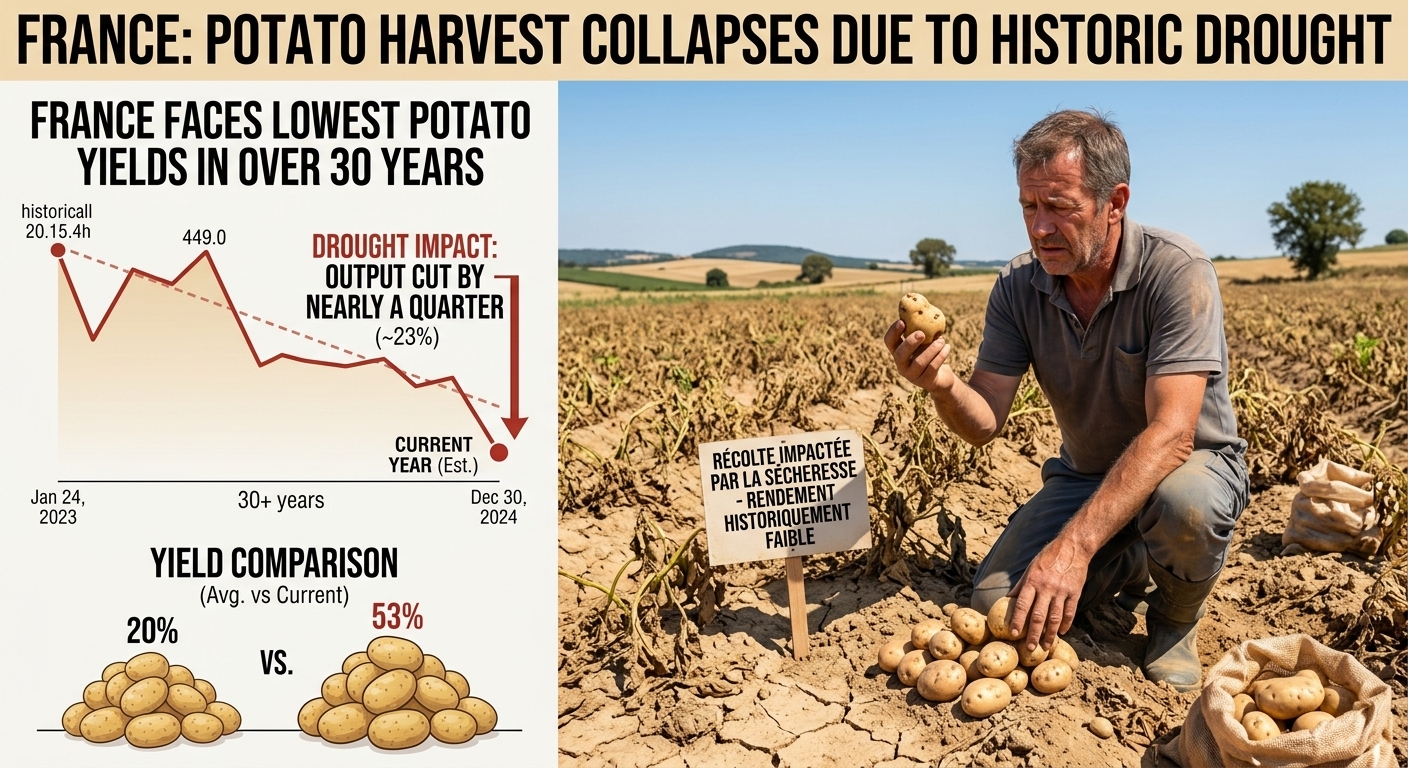
- 6.5 mln tonnes is the forecast crop, down from a record
- 23% fall in ware output, close to 2 million tonnes lost
- 37.4 t/ha forecast yield, 14% below last year's 43.5
- 173,415 hectares planted, 9.7% below the 2025 record
Kungani kubalulekile
- Kwabalimi
- The area cut was your own response to 0-2 euro per 100 kg; the yield loss was not. Going into contract talks, the 37.4 t/ha figure is a forecast from sample digs - your own dig results are the number to negotiate on.
- Okwamaphrosesa
- Two million tonnes missing in one country, with NEPG plantings down 11 percent, means the shortfall is regional. Contract cover matters more than origin switching, because the neighbouring supply cut its area too.
- Kwabahwebi
- Hauts-de-France alone holds almost 61 percent of the French area, so regional weather there moves the national number. Watch the harvest progression rather than the August forecast, which UNPT itself calls provisional.
- Kwabahlinzeki
- A 9.7 percent smaller planted area with yields a third below normal means less tonnage through storage, grading and handling this season - plan volumes down, and expect capital spending to follow farm income.
- Kwabatshalizimali
- The price collapse to 0-2 euro per 100 kg and the 11 percent planting cut across NEPG are confirmed; the 23 percent output fall is a union forecast from sample digs. Only the first pair is settled.
60-isekhondi isifinyezo
France, the EU’s second-largest producer, is heading for one of its sharpest production falls on record - a crop of around 6.5 million tonnes against a 2025 record. The growers’ union UNPT said on 24 August that ware output could fall about 23 percent, close to 2 million tonnes, on an average yield of about 37.4 t/ha: 14 percent below last year’s 43.5 and 13 percent below the five-year average of 43.1. If confirmed it would be the lowest average yield in more than three decades. Two forces drove it. The first was deliberate: after an oversupplied 2025, free-market prices across the NEPG region sat at 0 to 2 euro per 100 kg for months, and growers planted less - the 2026 ware area came to 173,415 hectares, 9.7 percent below the 192,099 record, with plantings down around 11 percent across the four NEPG countries. The second was the weather.
Growers’ and government forecasts both point to a crop of around 6.5 million tonnes, down from a record in 2025. The pressure is now shifting to contracts, crop quality and farm incomes.
France, the EU’s second-largest potato producer, is heading for one of its sharpest production falls on record. The national growers’ union UNPT (Union Nationale des Producteurs de Pommes de Terre) said on 24 August that ware potato output could fall by about 23% from 2025, a loss of close to 2 million tonnes. The union forecasts an average yield of about 37.4 t/ha, 14% below last year’s 43.5 t/ha and 13% below the five-year average of 43.1 t/ha. If confirmed, it would be the country’s lowest average yield in more than three decades.
The figures remain forecasts. The UNPT bases them on weekly sample digs across the main growing regions, and actual yields will become clearer as the main harvest progresses.
Izinsuku zeviki. Zikhiphe ohlwini ngokuchofoza okukodwa.
A planned cut met an unplanned shock
Two separate forces drove the decline.
The first was deliberate. After an oversupplied 2025 season, free-market prices across the North-Western European Potato Growers (NEPG) region stayed at €0–2 per 100 kg for months. French growers responded by planting less. A field survey carried out by the UNPT for CNIPT, the fresh-potato interprofessional body, put the 2026 ware area for fresh and processing markets at 173,415 ha. That is 9.7% below the record 192,099 ha of 2025. Hauts-de-France, the northern region at the heart of French production, accounts for almost 61% of the area. Across the four NEPG countries (France, Belgium, the Netherlands and Germany), plantings fell by around 11%.
The second was the weather. Météo-France reported that July 2026 was the hottest month of any kind recorded in France since national measurements began in 1900. The national mean temperature was 24.9°C, 3.8°C above the 1991–2020 norm, beating the previous record of 24.8°C set in August 2003. July rainfall was about 70% below normal, making it the third-driest July on record. Summer 2026 as a whole was also the hottest since 1900. The UNPT counted five spells of extreme heat during the season, and irrigation restrictions were in force in many areas.
Two independent estimates converge
The UNPT’s numbers are internally consistent. Multiplying the 2026 area by the forecast yield gives about 6.5 million tonnes (173,415 ha × 37.4 t/ha). The same calculation for 2025 gives about 8.4 million tonnes (192,099 ha × 43.5 t/ha). The gap is roughly 1.9 million tonnes, or 22–23%. (Editorial calculation.)
Agreste, the statistics service of the French agriculture ministry, reached a very similar result independently. Using data available on 1 August, it forecast production of storage and mid-season potatoes at 6.5 million tonnes, 22% below the 2025 record. Agreste attributes the fall to a 14% drop in area and a 9% drop in yield, with the average yield expected just below 40 t/ha, one of the lowest since 1996.
The two bodies use different methods. Agreste puts the area at 166,000 ha and defines the crop category differently. As a result, their yield figures and their split between area and weather effects differ, even though the total volumes almost match. Agreste also expects starch potato production to fall by 17%, mainly because of lower yields.
Tonnes lifted are not tonnes sold
The quality picture may matter as much as the volume. On 31 July, the French crop research institute ARVALIS reported wide variation between fields. It observed interrupted tuber bulking and secondary growth in some crops. Depending on severity, these problems can lead to misshapen or cracked tubers, uneven maturity and dry matter, glassiness, poor fry performance and higher storage risk. ARVALIS stressed that its observations should not be applied uniformly to the whole national crop.
The UNPT expects a higher share of small tubers. That is a particular concern for French fry processing, which depends on long tubers. Lots that fail contract specifications for size, shape, dry matter or fry colour may be downgraded or rejected, even though they count towards gross production.
Contracts move to the centre of the debate
Much of the French crop is grown under contracts that fix both tonnage and quality standards. In July, the UNPT and the Somme branch of the FDSEA farmers’ union advised growers expecting shortfalls to notify buyers before harvest. The aim was to create a written record of the expected deficit.
The UNPT has since requested crisis talks in GIPT, which represents the processing chain, and in CNIPT. It wants buyers to relax specifications so that sound potatoes outside normal size or appearance standards can still be sold. It is also seeking arrangements so that growers are not forced to buy replacement potatoes on the open market to cover volumes the weather prevented them from producing. The union is preparing guidance on French and Belgian contracts, covering force majeure, climate-risk clauses, RUCIP trading rules (the standard terms for the European potato trade), penalties and possible renegotiation.
The UNPT estimates grower losses at no less than €400 million and has asked the government for exceptional support for the worst-hit farms. The figure is an industry estimate, not yet backed by final harvest or farm-income data. Spread across the 2026 planted area, it equates to roughly €2,300 per hectare. (Editorial calculation.)
On 4 September, Agriculture Minister Annie Genevard announced an exceptional plan worth more than €1 billion for farmers hit by the heatwaves, drought and wildfires. The largest element is about €520 million through the national solidarity compensation scheme (ISN) for major crop losses. The plan also includes more than €300 million in local land-tax relief and a €235 million fund to help farms buy inputs such as seed and feed for next season. From the 2027 season, the reference period used to calculate yield losses will be extended from five to eight years, to better reflect repeated climate shocks.
The plan contains no measure aimed specifically at potato growers. A few days before it was announced, the arable crop associations of the FNSEA farmers’ federation, including the UNPT, had called for direct cash-flow aid of €450 per hectare.
What it means for the European market
According to Eurostat, France produced 17.9% of the EU’s potatoes in 2023, second only to Germany at 24%. The problem is not confined to France. On 24 August, the European Commission’s crop monitoring service (JRC MARS) forecast an average EU potato yield of 34.6 t/ha, 6% below the five-year average. Belgium, the Netherlands and Germany have also been hit by drought and heat.
The market is therefore entering the new season in the opposite position to a year ago: facing a shortage rather than a surplus. The effect on raw material prices for processors will not be straightforward, however. Contract terms for the 2026 crop were agreed in advance and at low levels. According to the NEPG, processors offered around €12.50 per 100 kg ex-field. The free market is likely to react first to the shortfall, and the main financial exposure falls on growers who cannot meet their contracted volumes.
It is too early to say how much fries and crisps will cost consumers. That will depend on harvest results across the NEPG region, crop quality and the outcome of contract negotiations.
The final scale of the losses will become clear only as lifting advances. Results are expected to vary widely with planting date, variety, soil type and access to irrigation. Late rain may help crops that still have green canopy, but it cannot recover yield potential already lost to early senescence.
Imithombo
- UNPT — 2026, vers une chute sans précédent de la production française (24 August 2026): https://unpt.fr/2026/08/24/2026-vers-une-chute-sans-precedent-de-la-production-francaise/
- Potato News Today — French potato production could fall 23% as drought and heat cut yields (24 August 2026): https://www.potatonewstoday.com/2026/08/24/french-potato-production-could-fall-23-as-drought-and-heat-cut-yields-lowest-yields-in-more-than-30-years/
- Euronews — Drought: French potato growers fear harvest slump (24 August 2026): https://www.euronews.com/2026/08/24/drought-french-potato-growers-fear-harvest-slump
- Reuters via Euronext — French potato crop to shrink by 23% after severe weather, growers say (24 August 2026): https://live.euronext.com/en/financial-news/french-potato-crop-shrink-23-after-severe-weather-growers-say
- Agreste — Infos rapides Grandes cultures, estimates as of 1 August 2026: https://agreste.agriculture.gouv.fr/agreste-web/download/publication/publie/IraGcu2698/2026_98inforapgdescultures.pdf
- Action Agricole Picarde — Des rendements au plus bas depuis 1996 ? (10 August 2026): https://www.action-agricole-picarde.com/des-rendements-au-plus-bas-depuis-1996
- Météo-France — Bilan climatique juillet 2026: https://meteofrance.com/presse/bilan-climatique-juillet-2026-est-le-mois-le-plus-chaud-et-un-des-plus-secs
- Météo-France — Bilan climatique de l’été 2026: https://meteofrance.com/presse/bilan-climatique-de-lete-2026-juin-juillet-aout
- French Ministry of Agriculture — Plan CASI (4 September 2026): https://agriculture.gouv.fr/plus-d1-milliard-deuros-debloques-par-le-gouvernement-pour-soutenir-les-agriculteurs-et-la
- Paysan Tarnais — FNSEA arable crop associations call for €450/ha aid (September 2026): https://www.paysantarnais.com/grandes-culturessecheresse-les-de-la-fnsea-demandent-une-aide-de-450-eurha
- Eurostat — The EU potato sector: statistics on production, prices and trade: https://ec.europa.eu/eurostat/statistics-explained/index.php?title=The_EU_potato_sector_-_statistics_on_production%2C_prices_and_trade
- Frozen Foods Biz / NEPG - Njengoba NEPG reports −11% ware potato planting, contract prices of concern (30 June 2026): https://www.frozenfoodsbiz.com/as-nepg-reports-11-less-ware-potato-planting-contact-prices-of-concern/
Isifinyezo Samazambane Omhlaba Wonke
Izindaba ezinhlanu eziphezulu, amanani, izexwayiso zezifo kanye nemicimbi. Ekuseni phakathi nesonto, akukho ukukhangisa.
Okulandelayo
The figures are forecasts. UNPT bases them on weekly sample digs across the main growing regions, and actual yields will become clearer as the main harvest progresses. The article notes pressure now shifting to contracts, crop quality and farm incomes.
Imithombo
- UNPT (Union Nationale des Producteurs de Pommes de Terre) statement of 24 August, based on weekly sample digs; area from a UNPT field survey carried out for CNIPT, the fresh-potato interprofessional body; regional price context from NEPG; weather from Météo-France. All production figures are forecasts, not measured harvest data.
Kuxhunywe kulokhu okuqukethwe
- Izwe
- France
- Izinkampani
- UNPT; CNIPT; NEPG; Météo-France
Izindaba ezihlobene
Amazambane Avunwa Emvuleni: Indlela Yokomisa Isivuno Futhi Usigcine Esigcinweni
Iqhwa Ngesikhathi Sokuvuna Amazambane: Indlela Yokugcina Ama-Tuber Aqandisiwe Angagcinwa