
PepsiCo Brazil: 120,000 Tonnes From 23 Contracted Growers, With Cold Storage Held as Operational Insurance
Ukuthatha okhiye
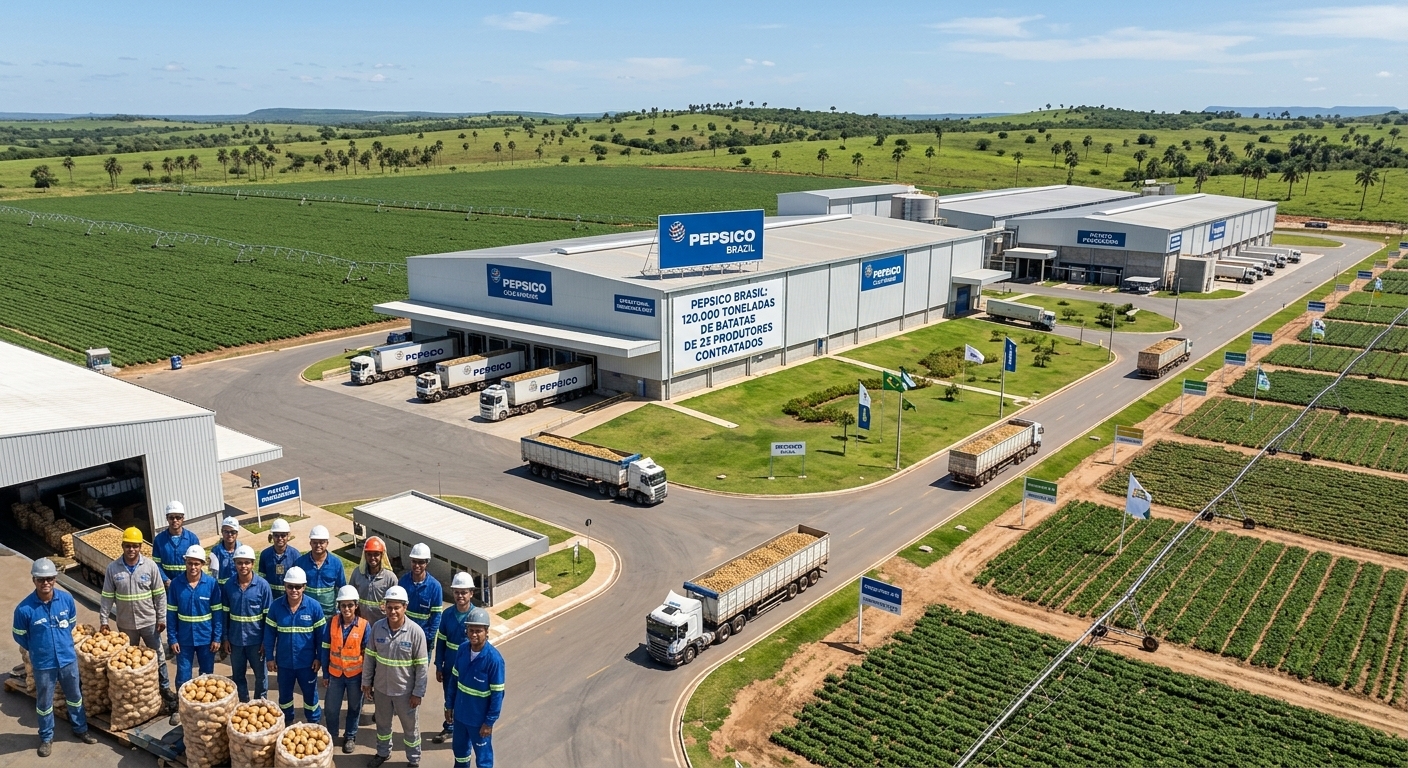
- 120,000 tonnes a year from 23 contracted growers
- Production spread across six Brazilian states
- Part of 450,000 t of wider farm procurement
- Cold storage held as buffer, not seasonal warehouse
- Proprietary FritoLay variety is the raw material
Kungani kubalulekile
- Kwabalimi
- Contracts sit across six states with different windows, so a grower is part of a rolling harvest — the schedule, not just the tonnage, is what the model buys.
- Okwamaphrosesa
- Cold storage used as insurance against interruption rather than as a season store is the operational point: it buys continuity of line supply, not just volume.
60-isekhondi isifinyezo
PepsiCo’s Brazilian chip supply runs on contract production across six states — Rio Grande do Sul, Paraná, Santa Catarina, São Paulo, Minas Gerais and Goiás — buying 120,000 tonnes of potatoes a year from 23 growers, within a wider 450,000-tonne agricultural procurement covering oats, maize, cocoa and coconut. Spreading production across different agroclimatic windows produces a rolling harvest and removes dependence on any single region or season, with cold storage held as a buffer against harvest interruption rather than as seasonal warehousing. The raw material is the company’s proprietary FritoLay variety, supported by a local Agro Science arm and breeding centre.
PepsiCo’s Brazilian chip supply chain runs on contract production spread across six states, with cold storage used not as a seasonal warehouse but as a buffer against harvest interruption. The company laid out the model at a supplier field day in Vargem Grande do Sul, São Paulo state, in early September 2026. The account was published by Brazilian outlet The AgriBiz, which discloses that its reporter travelled at PepsiCo’s invitation.
Supply base
PepsiCo buys potatoes from 23 growers across six states — 120,000 tonnes a year, part of a wider 450,000-tonne agricultural procurement that also covers oats, maize, cocoa and coconut for other product lines. Sources citing the company a year earlier put the grower count at 25. According to Dinheiro Rural (May 2025), the states involved are Rio Grande do Sul, Paraná, Santa Catarina, São Paulo, Minas Gerais and Goiás. Published annual volume estimates between 2023 and 2026 range from 110,000 to 125,000 tonnes; no source explains whether the variation reflects contracted volume or actual intake.
Spreading production across states with different agroclimatic windows produces a rolling harvest and removes dependence on any single region or seasonal window.
Izinsuku zeviki. Zikhiphe ohlwini ngokuchofoza okukodwa.
The raw material is PepsiCo’s proprietary FritoLay variety. The company runs a local arm of its Agro Science research operation in Brazil, including a breeding centre; Felipe Carvalho, agribusiness director at PepsiCo Brasil, describes proprietary genetics as the company’s main point of differentiation from competitors. As of February 2025, PepsiCo put domestic seed production at roughly 70% of requirement, with the balance imported from Chile and several European countries.
Storage as a hedge against lost harvest days
Up to 15% of the volume used is placed in cold storage for four to six months to cover seasonal demand peaks. The rationale is operational rather than seasonal. Carvalho puts it plainly: storage costs money, but on a rainy day when harvesting is impossible, the grower draws from the store and the line keeps running.
The company says it is investing in both building and leasing refrigerated capacity, and intends to increase its safety stock.
Carvalho’s reference to El Niño uncertainty is independently corroborated. The WMO’s August 2026 ENSO update reports that El Niño is firmly established and strengthening, with a near-100% probability of persisting through September–November 2026 and December 2026–February 2027, and further strengthening expected before a peak towards the end of 2026. A return to La Niña is not indicated over the forecast period.
For chipping potatoes — where storage must preserve processing parameters, above all reducing-sugar content governing fry colour — this means the buffer stock is being sized against a measurable rather than hypothetical risk in the coming season.
Ukuphatha ngemva kokuvuna
The cycle runs from harvest through in-field pre-cleaning to road transport to a packing facility. There the crop is washed in fully recirculated water and graded: medium-calibre tubers are selected, while undersized and oversized material — which will not yield a chip of acceptable dimension — goes to wholesale markets, including CEAGESP, as well as retail and school catering.
At the Grupo Cazarotto packing plant, which employs around 50 people, conventional gas convection drying with brush cleaning has been replaced by an infrared system. The company reports throughput gains and a lower carbon footprint but has published no figures.
From there the crop moves to one of PepsiCo’s eight Brazilian plants; potato processing specifically, per 2025 reporting, takes place at three — Curitiba (Paraná), Itu (São Paulo) and Sete Lagoas (Minas Gerais). Finished product is distributed through 65 centres nationally.
Fazenda Casa Branca, run by the Cazarotto family, has supplied PepsiCo for 15 years and received John Deere’s Smart Farm 2026 award. Marcelo Cazarotto describes the contract effect in terms of predictability: previously the operation was exposed to the market with no visibility on outcome; now there is a contract, and with production there is a price and a return.
Field-level technology: company-supplied figures
PepsiCo applies its own regenerative agriculture protocol, pep+, to its supplier base. The toolkit spans irrigation, soil preparation, planting and harvesting machinery, soil probes, fertilisers, crop protection, biologicals, drone and satellite crop analysis, solar panels, and advisory work on governance and business succession. Growers pay for the products and services themselves, in some cases in kind with produce.
According to the company: irrigation management cut energy use by 60% and enabled fertigation; machinery halved the tractor fleet and cut diesel use by 60%; AI-based tools improved plant establishment by 57%; biologicals are now applied across 90% of the potato area; and partner yields have doubled over 20 years.
All of these figures come from PepsiCo. The source does not specify the comparison base or perimeter — whether a single operation, protocol participants, or the entire supplier base. None has been independently verified. The yield-doubling claim also appears in 2023 coverage, but traces to the same corporate source.
Low-carbon programme with Yara
Separately, PepsiCo is running a reduced-carbon potato programme with Norway’s Yara. Growers access Yara’s ClimateChoice fertiliser line, produced using renewable ammonia and biomethane; PepsiCo pays the premium over conventional fertiliser, and Yara provides agronomic support. The pilot covers 130 hectares in Paraná with an expected 3,500–4,000 tonnes, and the first low-carbon harvest was taken in the opening months of 2026. In Europe, Yara has committed to supply PepsiCo with up to 165,000 tonnes of low-carbon fertiliser by 2030; in Latin America the partnership was previously rolled out in Mexico, Colombia, Chile and Argentina.
What transfers
Storage is costed against downtime, not against raw material price. A 15% buffer held for four to six months is insurance against being unable to harvest, not a seasonal stock position. The economics are assessed by weighing refrigeration cost against the cost of an idle processing line. With El Niño confirmed for the 2026/27 season, that calculation is live for any processor running on direct field delivery.
Geographic spread substitutes for financial hedging. Six production zones with distinct harvest windows deliver continuous intake. The cost is logistical and agronomic complexity; the return is removal of single-event weather exposure.
Infrared drying sits at the intersection of two gains. Replacing gas convection and brush cleaning with infrared reduces energy consumption while eliminating mechanical abrasion of the skin. No quantified data has been published on the changeover; the topic warrants separate research across infrared line manufacturers.
Limits of the model. The contract removes price risk from the grower but transfers capital expenditure to them — machinery, irrigation and storage are grower-funded, in some cases settled in produce. The entry threshold excludes smaller operations: 23 suppliers for 120,000 tonnes averages more than 5,000 tonnes per farm. The model is reproducible on a consolidated supply base and not reproducible on a fragmented one. Reliance on a single owner’s proprietary variety also means the grower’s agronomic choices are bounded by the processor’s breeding programme.
Isifinyezo Samazambane Omhlaba Wonke
Izindaba ezinhlanu eziphezulu, amanani, izexwayiso zezifo kanye nemicimbi. Ekuseni phakathi nesonto, akukho ukukhangisa.
Okulandelayo
Published annual volume estimates for 2023-2026 range from 110,000 to 125,000 tonnes, and no source explains whether the variation reflects contracted volume or actual intake. Grower count was put at 25 a year earlier.
Imithombo
- The AgriBiz — supplier field day, Vargem Grande do Sul, September 2026 (reporter travelled at PepsiCo’s invitation, as disclosed); Dinheiro Rural, May 2025
Kuxhunywe kulokhu okuqukethwe
- Izwe
- Brazil
- Izinkampani
- PepsiCo BrasilAgro Science
- izigaba
- Izindaba
Izindaba ezihlobene

IBulgaria: Intengo Yamazambane Athengiswa Ngobuningi Ikhuphuke Ngo-8.94% Ngeviki Yaya Ku-€0.64/kg Naphezu Kwezivuno Eziphezulu

I-Belarus: Umkhiqizo Wamazambane Wehle Ngo-65% Kusukela Ngo-1992 Waya Kumathani Ayizigidi Ezingu-3.1 Njengoba Imindeni Isakhula Ngo-76%


